
Architecture Before Guardrails
The same properties that inspire discussions about deterministic execution and formal verification must be rigorously applied throughout the coordination layers of the stack. Requirements beside a clean architecture on Zenon and Project Zeno, aligned by layer: coordination, governance, verification, recovery, execution, tool use, memory. Soon, high-stakes environments will be dominated by AI agents, machines, and robots, outnumbering humans by orders of magnitude.

The Fourth Room
For fifteen years bridges kept failing at the same seam: the moment one system decided whether to believe another. Verification and authorization were never the same responsibility — they only looked fused because every bridge inherited them that way. A speculative reading of what a Bitcoin Authorization Domain would be, why btcd was the clue, and why this fourth room only stands where verification-first separation already holds.

It Was Never About Block Size
Bitcoin keeps blocks small so ordinary people can run a full node. That makes verification cheap and throughput scarce. Execution-first chains made the opposite trade and closed the door on cheap verification entirely. Both are stuck on the same axis at opposite ends — and the real question is what architecture takes verification off that axis for good.

Smarter, then Faster
Execution was never the bottleneck; verification was, and almost no one worked on it. Zenon's Orangepaper separates verifying a Bitcoin fact from replaying the chain — bounded, offline, refusal-safe — a category execution-first chains can't enter without starting over.

The Verification Gap
Every enterprise blockchain control — frozen stablecoins, off-chain registers, single sequencers — compensates for one design choice: the shared-state execution environment. Five requirements follow from its failures, and one running permissionless network is designed to all five.

A Decade of Decentralization
Two architectural paths diverge after ten years. One continues post-hoc decomposition — Ethereum starting monolithic and bolting on rollups, oracles, DA layers, and provers, each patching the last while shared global state breeds MEV and unenumerable state explosion. The other composes purpose-built primitives by design: a block-lattice and Meta-DAG that separate canonical ordering from local execution, bounding state and eliminating MEV at the protocol level.

Bitcoin Techno-Maximalism
A structural companion to Saylor's Four Ideologies. Scaling Bitcoin to eight billion isn't one problem but three — throughput, verification, ordering — and only three architectures answer them. TradFi centralizes honestly, with courts and recourse. Monolithic state machines centralize with deniability, sliding from MEV to a censoring Ministry of Truth. A block-lattice and meta-DAG decline to manufacture global order at all — the only path that scales without concentrating it.

End of an Era: The Blockchain Trilemma
The trilemma is not a law of nature — it is the symptom of one architectural decision: fusing ordering and execution into a single global act, so every node re-executes every transaction. Distributed systems solved this forty years ago. Separating the two dissolves the triangle rather than balancing it. Fabric narrowed the conflict surface; Zenon's block-lattice and metaDAG narrow it to the minimum — only verify what you need to execute.

Formal Verification: Foundation of Blockchain x AI
Formal verification proves a system satisfies its properties with certainty — exhaustive guarantees, not the partial coverage of testing. For AI agents transacting on blockchain rails, that certainty is the precondition for trust at scale. Execution-first chains make it intractable; a block-lattice with meta-DAG separates canonical ordering from local execution, turning verification into a first-class, low-cost operation.

The MEV Gaslight
The entire MEV mitigation industry shares one unexamined premise: that extraction is an emergent pathology of open markets. It isn't. MEV is the product of a single architectural decision — fusing ordering, semantic interpretation, and execution into one omniscient validator. Encrypted mempools and PBS patch the holes in a sieve. A block-lattice and metaDAG distribute those prerequisites across actors who cannot recombine them, so the machine that produces extraction is never assembled.

The Wrong Layer Part II: The Strange Node
If Zenon wants programmability, the process of elimination converges on WASM extension chains. Working from years of Kaine’s public messages, the design space narrows to a single direction: execution outside L1, data and proofs through Sentinels, shared-security validation by Pillars, anchoring in Momentum, settlement on account chains. The architecture was implied years before the industry had the vocabulary.
The Wrong Layer
Nano proved the global ledger was not a law of nature. Vite tried to extend block-lattice to smart contracts and lost composability — execution on the wrong layer. A three-layer thesis: account chains settle, the commitment chain anchors state and proofs, and off-chain proof-carrying execution returns results trustlessly.
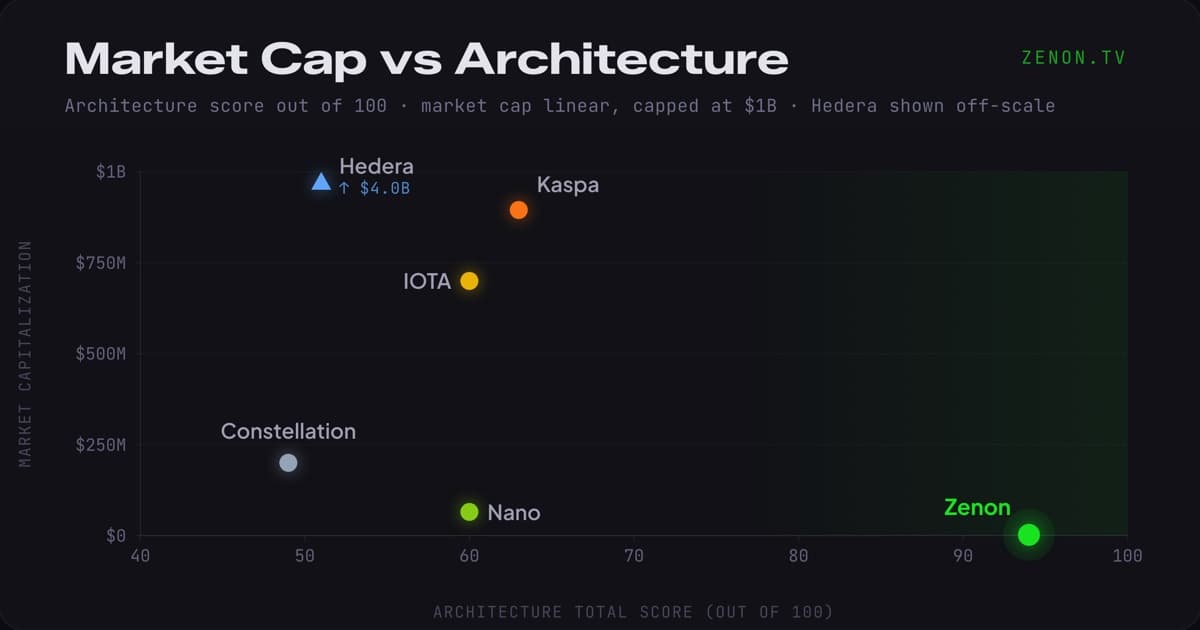
The DAG Paradox
The directed acyclic graph is, on the merits, the correct data structure for a trustless settlement layer — and almost nobody uses it. Six DAG projects ranked across architecture, economics, and survivability. Sort by market cap to see the inversion; sort by architecture total to see where correctness diverges from adoption.

Event Horizon Part II: A Time Slip
A documentary essay on what it would have actually cost to build Zenon's Phase 1 in 2021 — a venture-scale staffing problem disguised as a technical one. Five technological curves (recursive proofs, libp2p, FROST, DAG consensus, AI-assisted implementation) converged between 2022 and 2025. The architecture did not become better. The environment became compatible with it.

Reconstructing Phase 1
A verification-first reading of Zenon's Phase 1 architecture, drawn from several hundred public messages from Kaine. Cheap independent verification is the constraint that ties libp2p, Sentinels, dynamic Plasma, TSS-held BTC vaults, and ZK bootstrapping into a single coherent stack — substrate before application, verification before execution.

Spam, Storage, and the 16 KB Data Field
A framework for reasoning about resource abuse in Zenon’s dual-ledger architecture. Why the 16 KB data field ceiling is calibrated for post-quantum cryptography, how admission control operates as a multi-timescale control system, and what Dynamic Plasma must resolve.

A Sovereign Verification Kernel for Decentralized Intelligence
The anti-monolith thesis is correct: intelligence emerges from networks, not god-models. The question is whether the coordination layer beneath those networks will centralize under its own overhead, or whether a sovereign verification kernel can keep composition clean and verification cheap regardless of scale.

Move Packets, Don’t Trust. Verify
In 1977, Postel identified the architectural mistake of bundling routing and reliability. Bitcoin applied the same discipline: do one irreducible thing. Zenon completes the stack. IP moves packets. Bitcoin orders events. Zenon verifies them.

What is Zenon Plasma?
Zenon rejects the gas axiom. Plasma is not a fee — it is proof of cost, generated through computation or capital. PoW Plasma lets any device transact with zero token balance. QSR fusion provisions regenerating capacity without burning anything. The result: internet-native access for browsers, IoT, AI agents, and first-time users.

ISO 20022: A Blockchain Odyssey
Safety-critical standards across aviation, nuclear, automotive, medical, and financial systems converge on the same engineering principles. This paper maps those principles to blockchain architecture and demonstrates structural alignment with verification-first design.

Why Crypto is Stuck in 2014 — Part 2
From threads to fabrics: how the leap from blockchain to DAG mirrors the telephone-to-network transition, and why the Network of Momentum is the internet of blockchains.

Why Crypto is Stuck in 2014
Each computing breakthrough adds exactly one dimension the layers below could not provide. Ethereum collapsed that hierarchy. The dimensional error that constrained the blockchain industry for over a decade.

Anatomy of a Full Stack Blockchain
The irreducible primitives a blockchain must handle beyond payments: access, order, execution, data availability, storage, verification, global order, and identity as clean architectural axes.

The Next Evolution of the Internet
From IP to Bitcoin to the block lattice. How the intellectual lineage from Bitcoin’s lightweight ordering chain leads to a dual-ledger architecture that completes the verification-first vision.
A Claim Is Not a Record
Scientific and industrial pipelines record provenance in a metadata field — a string, inside the file, that the file asserts about itself. It can be edited with no trace, carries no independent timestamp, and binds to nothing it describes. The fix is not a better field: it is committing the digest and the declared source together under the instrument's own key, on a ledger nobody involved controls. A verification-first reading of why machine-generated records — sensor networks, autonomous agents, automated laboratories — still vouch for themselves, and why the obstacle turns out to be a line item rather than a cryptographic one.
Interstellar OS Stack: Separating Ordering and Interpretation
Most protocol designs are wrong in the same way. They bundle ordering and execution, then spend years building workarounds. The Interstellar architecture separates them at the foundation: consensus establishes the log, interpretation derives the state. Verification cost becomes independent of execution complexity.
Zenon: The Super Gravity of a Black Hole
Verification-first architecture occupies a quadrant that no execution-first chain can credibly move into without ceasing to be itself. Time does not merely favor Zenon — time forces the world toward it. A structural thesis on why the industry’s trajectory bends toward a single inescapable region.
The Machines That Read Truth
Ten million autonomous agents at one task per second each. 864 billion operations per day. The verification inequality decides everything: verification must be cheaper than trust, or systems recentralize. Zenon’s architecture was designed for this selection pressure before the demand existed.
The Planetary Scale Superorganism: Verification Loop Theory
Finding the right answer is hard. Checking whether an answer is right is easy. When AI meets verification-first architecture, the development loop runs at the speed of compute, not the speed of human interpretation. The trajectories diverge and they don’t come back together.
What is the Bitcoin Momentum Invariant?
Bitcoin requires a minimum rate of security spend — denominated in BTC, not dollars — below which the cost of attack drops beneath economic rationality. Price cancels out. The invariant must be satisfied continuously.
Decentralization by Topology
Decentralization isn’t moral. It’s measurable. Three axes — trust topology, computation locus, and access sovereignty — expose the gap between narrative and reality across blockchain architectures.
Don’t Trust, Attempt to Falsify
Karl Popper broke philosophy of science by inverting the question. Zenon applies the same inversion to blockchain: verification is attempted falsification, and REFUSED is the honest answer that makes light clients first-class participants.
Sovereignty, Not Decentralization
Decentralization is the industry’s most abused metric. The property worth optimizing is sovereignty: the architectural guarantee that participants can access, transact, verify, and exit without permission.
5 Eras of Blockchain Computing
From the Timechain to the Sovereign Era. A five-era framework for blockchain composability, splitting the Cloud era into MiniTruth and Sovereign.
Billion-Dollar Maybe
From Hoare’s null reference to blockchain’s verification gap — why the field abandoned verification-first design, how refusal semantics and proof markets recover it, and why Zenon’s dual-ledger architecture makes bounded verification structurally possible.
What Does Zenon Have to Do with Bitcoin?
Bitcoin proved that trustless verification works. Zenon makes it composable. How a feeless verification layer extends Bitcoin’s architectural philosophy to general-purpose state.
Bitcoin’s Unfinished Constraint Part II: Verify Bitcoin, Don’t Bridge It
How verification-first systems can strengthen Bitcoin’s SPV model without modifying Bitcoin, by committing to ordered state rather than requiring re-execution.
Bitcoin’s Unfinished Constraint Part I
Examines a single architectural invariant introduced in early Bitcoin design: verification must remain cheaper than execution. Why the industry abandoned it and where the line of thought quietly resumed.
Do Not Kill Humans: Design Tips for AI and Blockchains
From the Therac-25 to seL4 to Bitcoin, why every safety-critical engineering discipline converges on the same invariant: verification must be budgeted before execution is designed.
The Empty Quadrant
An architectural analysis through a two-dimensional framework: execution-first vs verification-first, and payment-only vs general-purpose state. Why the verification-first quadrant remains unoccupied.
Verifiability and Fate-Sharing in a Cryptographic Hourglass
How a narrow waist of cryptographic commitments enables transport-independent verification, and why the hourglass model that scaled the internet applies to distributed ledgers.
You Can’t Hide Once You Run
Fifty billion devices and autonomous AI agents are arriving on infrastructure that cannot distinguish truth from fabrication. Why verification-first architecture must precede pervasive autonomy.