The Asymmetric Opportunity
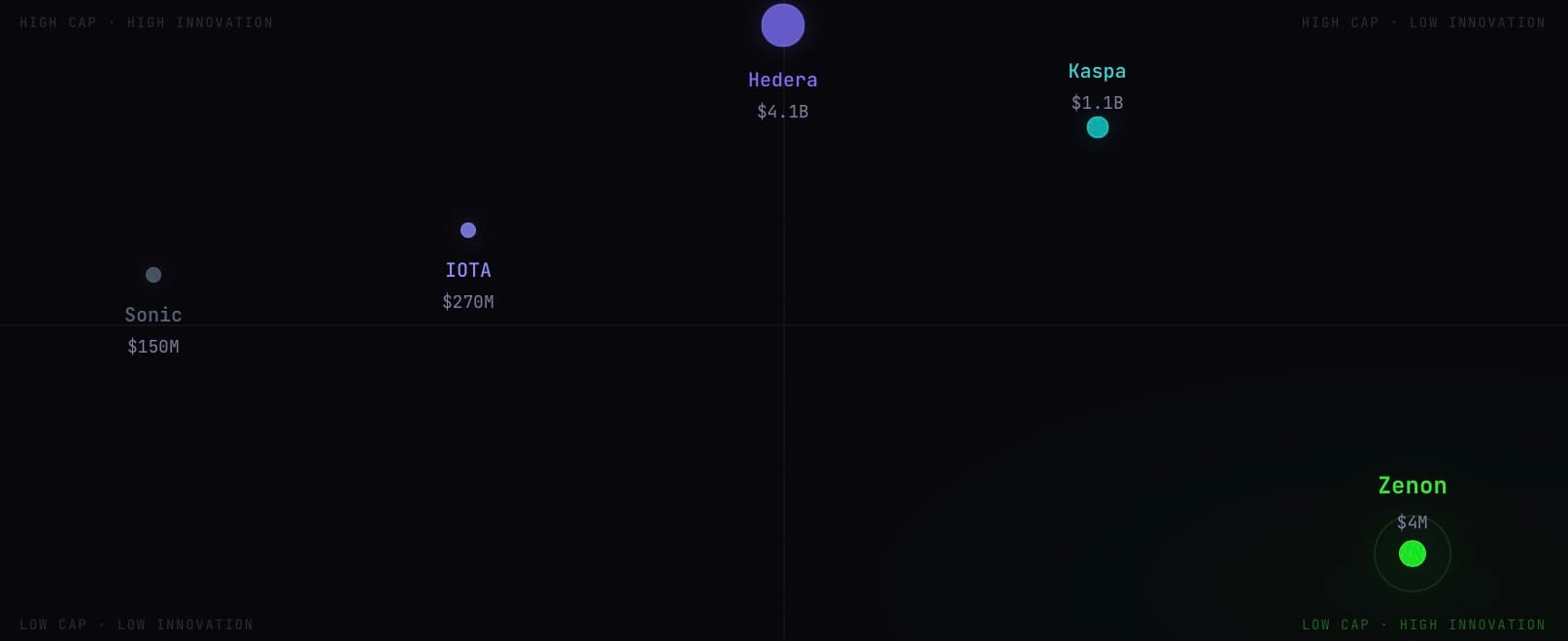
DAG Architectures Ranked by Innovation vs. Market Capitalization
The market for directed acyclic graph architectures in distributed ledger technology has settled into a familiar pattern. Projects with enterprise partnerships, exchange listings, and marketing budgets command valuations in the billions. Projects with novel architecture and no marketing budget trade at a rounding error. The question worth asking is whether the market is pricing architecture at all, or whether it is pricing something else entirely.
The Landscape
Five DAG-based protocols represent the current state of the art, each approaching the scalability trilemma from a distinct structural position.
Hedera ($4.1B) operates a hashgraph consensus built on an event DAG, achieving asynchronous Byzantine Fault Tolerance through gossip-about-gossip propagation and virtual voting. The architecture delivers enterprise-grade throughput and sub-second finality. Its governing council model trades full permissionlessness for predictability, a deliberate and defensible choice for the institutional use cases it targets.
Kaspa ($1.05B) generalizes Nakamoto consensus into a BlockDAG via the GHOSTDAG protocol, incorporating all valid parallel blocks rather than discarding orphans. It retains pure proof-of-work security while achieving block rates exceeding one per second. The elegance lies in what it preserves: Bitcoin’s security model, extended to parallel block production without sharding or external layers.
IOTA ($270M) pioneered the transaction-level DAG with the Tangle, where each transaction directly approves prior ones, eliminating the distinction between users and validators. Post-Coordicide upgrades introduced Mana-based congestion control and removed the centralized coordinator, fulfilling the original design vision of a feeless, leaderless, massively parallel validation layer optimized for machine-to-machine economies.
Sonic ($150M), formerly Fantom, processes an event-based DAG through the Lachesis consensus engine with asynchronous BFT guarantees, then linearizes the output into an EVM-compatible execution chain. The architecture balances DAG parallelism with the developer ecosystem and tooling that Ethereum compatibility provides.
Zenon ($3.7M) operates a meta-DAG dual-ledger architecture that separates transaction processing from consensus ordering at the protocol level. A per-account block-lattice handles transaction execution in parallel, while a distinct consensus DAG achieves global ordering through vote-weighted proof-of-stake and super-quorum selection. Spam resistance comes not from fees but from Plasma, a rechargeable resource staked through the QSR token. The consensus mechanism combines leaderless BFT with hybrid PoW/PoS validation.
The Dislocation
The architectural ranking and the market ranking run in opposite directions.
The protocol ranked fifth by architectural innovation (Sonic, an EVM-compatible linearization of a DAG) commands a market capitalization roughly 41 times larger than the protocol ranked first (Zenon, the only dual-ledger meta-DAG with native separation of concerns between transaction processing and consensus ordering).
Hedera, ranked third architecturally, trades at 1,108 times Zenon’s valuation. Kaspa, ranked second, trades at 284 times. These are not small discrepancies explained by differences in token supply or circulating float. They represent a structural mismatch between what the market values and what the architecture delivers.
Every other project on this list processes transactions and achieves consensus within a single structural layer. Zenon is the only protocol that treats these as fundamentally separate concerns, assigning each to a purpose-built ledger. The block-lattice handles asynchronous, parallel transaction execution at the edge. The momentum ledger handles minimal, deterministic consensus at the core. This separation is not an optimization. It is a different category of design, one that enables native sharding, feeless operation, and linear scaling as a structural property rather than an aspirational roadmap item.
What the Market Prices
Markets are efficient at pricing liquidity, narrative momentum, exchange access, and institutional familiarity. They are not efficient at pricing architectural novelty in systems that have not yet reached critical adoption mass.
Hedera’s 93M in inflows, and seven years of enterprise integration. Kaspa’s $1.05 billion reflects a fair-launch ethos, academic pedigree from Yonatan Sompolinsky’s research, and a growing mining ecosystem. These are real and meaningful signals of ecosystem health.
What they are not is a measure of architectural merit. The market has not yet attempted to price the question of which DAG architecture most completely resolves the fundamental tensions between parallelism, security, and decentralization. When it does, the project trading at $3.7 million with the most structurally complete answer to that question represents the widest asymmetry in the space.