Zenon: The Super Gravity of a Black Hole
Before Settling In for the Long Nap
What follows is the thesis that emerged from an exhaustive excavation of the Zenon network, its architecture, its history, and the structural forces shaping the broader blockchain landscape. We did not begin with this conclusion. We arrived at it. Whether it ages like fine wine or milk is not for us to say. That judgment belongs to time, and to you, the reader.
The conclusions presented here may appear disproportionate given Zenon’s current market footprint. They are not derived from speculation, but from extended architectural analysis and comparative research across the broader blockchain design space.
If present trends continue, the shift may resemble the historical movement from walled-garden platforms such as AOL toward open, general-purpose browsers. From this perspective, the open question is less if such a transition occurs, and more when it becomes unavoidable.
The history of blockchains so far has been dominated by a single, seductive premise: that the winning network must be a global computer. On this view, the chain that executes the most contracts, hosts the most apps, and captures the most value is destined to be the center of everything. This is the execution-first mental model, and a trillion dollars of infrastructure, speculation, and careers are anchored to it.
But under the surface, another gravitational field is forming — quiet, dense, and structurally unavoidable. Zenon’s verification-first architecture occupies a quadrant that no existing chain can credibly move into without ceasing to be itself. That is not a marketing claim. It is a structural constraint baked into what execution-first chains are. And if that constraint is real, then time does not merely favor Zenon; time forces the world toward it. Systems built on different assumptions begin, slowly and almost unintentionally, reorganizing themselves around it — not because they are persuaded, but because alternative paths grow increasingly complex and unstable. In that sense, Zenon is less a competitor and more like a black hole: a super-gravity in design space that bends every trajectory toward a single inescapable region. A region where verification becomes cheap enough to run inside a browser and liquidity stops needing to move in order to exist globally.
The Wrong Premise: Execution as the Center of Gravity
Execution-first systems begin with an assumption so deeply internalized it is rarely questioned: a blockchain is, fundamentally, a shared global machine.
From that assumption follow all the familiar structures. Every full node re-executes transactions to maintain a shared state. The chain aspires to be the primary venue for value custody and settlement. Cross-chain interaction is modeled as movement of value — wrap it, bridge it, lock here, mint there.
Ethereum is the archetype: a large, expressive, globally shared computer optimized to be the locus of programmable money and applications. Every other L1 and L2 rearranges the parameters — throughput, latency, fees, language, data availability — but the premise remains unchanged.
This architecture has a structural cost that its builders did not fail to notice. They chose to pay it. The cost is that every coordination problem must be routed through a monolithic execution environment, and trust must be anchored in the correctness of a heavyweight VM, its client implementations, and the incentives of its validators or sequencers. In a world with one chain, this might be acceptable. In a world with many sovereign chains — each with its own economics, culture, and security assumptions — it is a walled garden mistaken for the internet.
The trap is subtle: because execution-first systems can simulate almost anything at the logical level, it is easy to assume they should be the center of everything. That is the trillion-dollar mistake. The problem is not what they can compute. The problem is what they are structurally forced to be.
The Weight of Execution: State Bloat as a Structural Tax
The abstract cost of execution-first architecture has a very concrete expression: disk. Every transaction executed, every account touched, every state transition committed to a global shared machine leaves a permanent physical residue. That residue is not a bug. It is the price of the premise.
Solana makes this legible in numbers that are difficult to dismiss. As of early 2025, an unpruned Solana ledger sits at approximately 400 terabytes on disk, growing at 80 to 95 terabytes per year at current traffic levels. That figure is conservative — it captures ledger entries, not the full state footprint. Solana’s account-based model generates an estimated 5 to 7 petabytes of state data annually when indexes and accounts database are included, with the ledger component alone adding roughly 100 terabytes per year. And this is before the network approaches anything close to its design throughput. If usage ramps toward Solana’s full design capacity, raw block data alone is estimated to grow at several petabytes per year.
Project that forward five to ten years on a network actively positioning itself as global financial infrastructure, and the arithmetic becomes uncomfortable. At current growth rates, the ledger alone clears one petabyte before 2030. With state and indexes included, total storage requirements move into multi-petabyte territory within a decade — and that assumes no meaningful increase in adoption. A Solana that actually achieves its institutional ambitions generates data at a rate that strains the definition of what a “decentralized” node operator can sustain.
This is not a storage optimization problem. It is a structural consequence of what execution-first systems are. Every chain that defines itself as a global computer is in the business of accumulating the history of everything that has ever run on it. The architecture demands it. The social contract demands it. Independent verification — the thing that makes a chain trustless rather than merely fast — requires that someone, somewhere, holds the full record. As that record grows toward petabyte and eventually exabyte scale, “someone” quietly narrows to “institutions with data center budgets.” The promise of independent verification begins to hollow out from the inside.
The technical mitigations that exist — state compression, pruning, archival tiers — solve symptoms without touching the premise. They reduce what any individual node must hold at a given moment, but they do so by reintroducing the trusted intermediaries that blockchains were supposed to remove. A pruned node outsources historical truth to an archival provider. A compressed-state node trusts that the compression scheme was applied correctly and that the canonical reference is maintained somewhere reliable. This makes comprehensive state indexing both technically complex and financially unsustainable at scale.
The verification-first framing offers a different answer — not “how do we store less of the global state” but “why are we committing every computational act to a shared global ledger in the first place?” When execution is local and only verifiable commitments are globally ordered, the ledger records proofs of outcomes rather than the full history of every operation that produced them. The data footprint of a proof is orders of magnitude smaller than the data footprint of execution. The difference is not incremental. It is architectural.
State bloat, in this light, is not merely an engineering inconvenience. It is execution-first’s bill coming due — the cumulative physical weight of a decade-long bet that global truth requires global re-execution. That bill grows faster than the networks paying it, and no optimization within the execution-first quadrant settles it. It can only be avoided by starting somewhere else.
The Locked-In Path: Why the Industry Missed Verification-First
The industry did not fail to discover verification-first because it was impossible. It failed because execution captured incentives first.
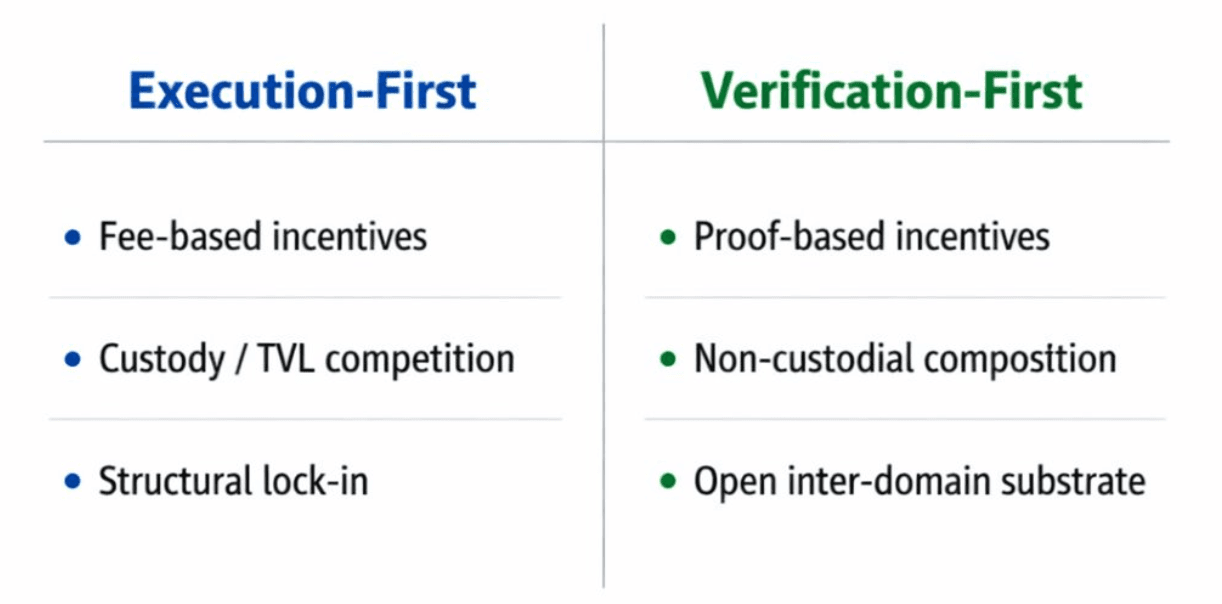
Entire ecosystems formed around being the place where activity happens, not the place where truth is proven. Developer communities, VC theses, token models, and social identities all crystallized around that activity-first framing. Once that path dependency formed, reversal became economically irrational. A chain cannot pivot away from being the execution center without abandoning the fee revenue, the TVL, and the community narrative that its entire existence justified. The architecture and the incentives locked together. The quadrant went unoccupied — not because it was unimportant, but because no entrenched system could afford to stand in it.
This is not a failure of vision. It is a failure of genesis. To occupy the verification-first quadrant, you had to start there before the payoff was obvious.
The Missing Quadrant: Verification-First
A different starting point leads to a different universe. Instead of asking, “How do we build the ultimate computer?” the verification-first question is:
How do we build the minimal, neutral infrastructure that makes it cheap and trustless to verify what other systems have already done?
From this inversion, several principles follow. Execution is local: each domain — Bitcoin, Ethereum, an appchain, a specialized rollup — runs its own logic under its own rules. Verification is global: there exists a shared substrate whose primary job is to order proofs and commit state roots so that anyone can verify specific facts cheaply. Custody is avoided: assets stay on the chains where they are natively secured, and cross-domain interaction is driven by proofs of external state, not rehypothecated IOUs.
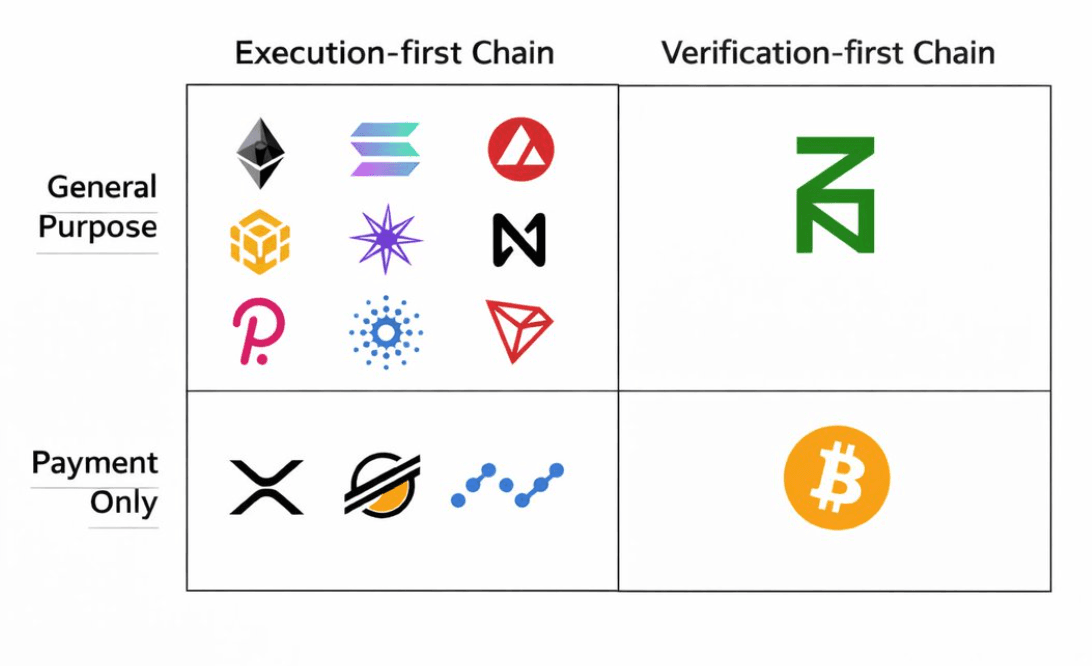
Zenon’s architecture is explicitly designed around this role. Its dual-ledger structure — account-chains for user activity plus a Meta-DAG of globally ordered “Momentums” committing state — doesn’t exist to host yet another world of contracts. It exists to create a canonical, consensus-backed timeline of verifiable claims about state, both local and external.
In that design, the consensus layer is not a VM scheduler; it is a proof bus. It doesn’t need to own the logic or the assets. It needs to make statements about them objective, ordered, and cheaply attestable. In practice, this means a cross-domain proof lifecycle that looks like this: a state commitment is produced on a sovereign chain, captured and ordered inside a Zenon Momentum, and then exposed as a verifiable claim that a browser-based light client can check directly — without trusting an RPC operator, without bridging assets, without a centralized intermediary asserting what is true. The proof moves; the assets do not. This is not a tweak to the execution-first model. It is a different quadrant entirely.
The Payoff: Browser-Native Verification and Global Liquidity
Execution-first chains talk about “mass adoption” while requiring users to outsource truth to servers. That is not adoption. That is renting credibility.
Verification-first flips the economics of trust. When the base layer is a proof bus — when state commitments are ordered, objective, and cheap to check — a light client stops being a separate product. It becomes a default mode of interaction: a browser tab that can verify what’s true without asking permission from an RPC endpoint.
That is the real unlock: browser-native light clients. Not “light clients” as a compromise. Light clients as the primary interface.
And once verification becomes browser-native, liquidity stops needing to move to become usable. Liquidity becomes globally addressable. You don’t bridge assets into an execution silo just to trade them. You prove external state and settle intent against native assets where they already live.
This is what “global liquidity” actually means: not one chain holding everyone’s money, but one neutral layer making everyone’s money verifiably readable and safely usable across domains.
Bitcoin quietly introduced a constraint that the industry never fully resolved. If independent verification is the foundation of trustless systems, then verification must eventually become cheaper than execution — cheap enough to live inside the interface itself. Full nodes proved truth through re-execution, but that model does not scale to a multi-chain world where countless independent systems produce state simultaneously. SPV revealed a path forward by separating verification from execution, yet it remained confined to Bitcoin’s own ledger. The unresolved question was never how to scale computation, but how to preserve independent verification once computation fragments across many sovereign chains. A system capable of ordering and exposing verifiable commitments across domains is not an alternative to Bitcoin’s model; it is the natural consequence of taking Bitcoin’s verification constraint seriously in a multi-chain universe.
The SPV Promise, Finally Completed
Bitcoin introduced a radical idea with Simplified Payment Verification: users should be able to verify truth without running the entire system. But SPV stopped halfway. It allowed verification of inclusion, not verification of broader state or cross-system facts. Over time, wallets quietly drifted back toward trusted servers because verifying everything remained too expensive for ordinary interfaces.
Verification-first architecture resumes that unfinished trajectory. When proofs are globally ordered and cheap to check, verification no longer belongs only to infrastructure operators. A browser can verify commitments directly. A wallet no longer asks a server what is true; it checks. The original promise of SPV — independent verification without institutional dependence — stops being a compromise and becomes the default mode of interaction.
In that sense, verification-first is not competing with Bitcoin. It is extending the constraint Bitcoin introduced. SPV proved that execution and verification can be decoupled. Zenon universalizes that decoupling across chains. Truth must remain independently checkable, even as the system becomes multi-chain.
Execution-first tried to scale computation. Verification-first scales the ability to know what is true.
Irreversibility: The Self-Overthrow Problem
Here is the structural fact that execution-first chains cannot maneuver around: to become genuinely verification-first, they would need to renounce the thing that defines them.
An execution-first chain is defined by the centrality of its VM, the tight coupling between block production, execution, and state transition, and a social contract that promises to be the main stage for applications and liquidity. To move into the verification-first quadrant, such a chain would need to say: We are no longer the place where your logic runs by default. We will not strive to custody your assets; we will strive to observe and prove external systems. Our primary product is objective verification, not programmable execution.
That kind of shift is not an upgrade. It is a self-overthrow. Economically, it abandons fee and TVL ambitions. Socially, it invalidates years of messaging. Technically, it demands restructuring data models and consensus goals around proofs rather than stateful computation.
Execution-first chains cannot make this move without becoming fundamentally different systems. At best, they can imitate the surface — add proof markets, integrate external light clients, expose verification APIs — while remaining execution-first at their core. The quadrant that says our purpose is neutral verification is effectively closed to them. It requires the freedom of a new genesis, before the narrative crystallized, before the incentives locked.
Zenon had that freedom. It used it.
The dependency chains make the lock-in explicit. An execution-first chain cannot slide from the execution column to the verification column without unwinding every economic relationship its ecosystem was built on. That is not a technical migration. It is an identity replacement.
Verification-First Is Not Modularity
At first glance, verification-first can resemble the modular vision emerging from execution-first ecosystems. Rollups externalize execution. Data availability layers separate storage. Zero-knowledge proofs reduce verification cost. But the center of gravity remains unchanged: these systems still assume a privileged settlement layer that ultimately defines truth. Execution moves to the edges; authority does not.
Verification-first makes a different move. It does not ask multiple systems to converge onto one chain’s authority. It creates a neutral ordering layer whose purpose is to observe and attest to many sovereign systems without requiring them to subordinate themselves to it.
Modularity distributes execution. Verification-first removes the need for a center.
Put another way: modularity redistributes computation; verification-first redefines authority.
That distinction is subtle technically — and absolute architecturally.
Recent developments inside Ethereum’s own research direction unintentionally illustrate this gravitational pull. The emerging “strawman” roadmap increasingly emphasizes real-time proving, succinct verification, and validator roles that attest to correctness rather than re-execute ever-growing computation. None of these changes represent a departure from Ethereum’s execution-first identity; the chain remains organized around scaling its global computer. Yet the direction is revealing. As execution complexity rises, the system is forced to import verification as a stabilizing mechanism. Proofs begin to replace recomputation not because philosophy changed, but because engineering constraints demand it. What appears as incremental optimization is, at a deeper level, a sign that even the largest execution-centric systems are being pulled toward architectures where verification becomes cheaper, more central, and ultimately more valuable than execution itself. The destination has not changed — but the trajectory has begun to bend.
Zenon as a Black Hole in Design Space
Black holes do not compete. They simply make every alternative trajectory more expensive. That is the correct frame for what Zenon represents in protocol space.
Consider what the physics implies:
Bridges are orbital instability. Every wrapped asset is a bet that two execution environments will remain synchronized indefinitely. Bridge exploits are not engineering failures — they are the gravitational cost of pretending assets can exist in two places. Each exploit increases pressure for something that doesn’t require the fiction.
Wrapped assets are escape velocity hacks. Moving value across execution silos requires constructing elaborate mechanical systems to simulate what verification of external state would provide natively. The complexity accumulates. The risk compounds.
RPC is the hidden bridge. Most “multi-chain UX” today is just remote procedure calls with marketing on top. The user’s wallet becomes a thin client that can’t verify state, so it delegates truth to infrastructure operators. That is custody-by-another-name: not of assets, but of facts. The industry calls this decentralization, but the interface still asks someone else what is true. Execution-first removed banks from custody but quietly reintroduced them as infrastructure providers. Verification-first removes them from truth itself.
Browser verification collapses the stack. When verification is cheap, you don’t need a privileged server to tell you balances, fills, or finality. You need proofs. The interface becomes sovereign. A web app can behave like a full participant — bounded, but real — because it can check commitments directly.
Execution hubs are local gravity wells. They exert real pull on the applications and liquidity within their orbit. But their gravity is local. They cannot become the reference point for a multi-chain universe without claiming authority over chains that have no reason to grant it.
State is the bill that never stops growing. Every execution-first chain is accumulating physical debt — petabytes of ledger history that grow faster than the storage economics can justify for independent operators. What begins as an engineering challenge becomes a centralizing force. The node operator cohort narrows. The promise of independent verification quietly expires. Verification-first doesn’t manage this bill. It doesn’t accrue it.
Zenon’s significance is not that it is “the next fast chain” or “another ecosystem.” Its significance is that it planted itself precisely at the center of the verification-first quadrant before that quadrant was widely recognized — and that, by design, it is the one thing entrenched execution-first systems cannot become.
Several properties follow from this position. Its base design is optimized around ordering, state commitments, and bounded verification — not around being the richest execution venue. That clarity of purpose accumulates like mass. And just as Bitcoin’s launch conditions cannot be replayed once “we know what Bitcoin is,” a chain that chose verification-first early — before the narrative payoff — holds a historical position that later copycats can replicate in code but never in fact.
Super Gravity and the Fate of Execution-First Empires
What happens to execution-first empires in a universe where verification-first becomes widely understood?
In the near term: dismissal. They will call it niche, redundant, or solved. They will reframe themselves as “also verification layers” without relinquishing their execution-centric identity. They will build proprietary bridges and proof systems designed to keep flows inside their walls.
But structural forces do not negotiate with near-term positioning. The cost and risk of bridges and wrapped assets accumulate. State bloat compounds silently until it does not. Users, institutions, and regulators begin to prefer architectures where assets remain on their native chains and cross-domain behavior is anchored in objective proofs. Regulators don’t actually want “more chains.” They want fewer non-auditable black boxes. Verification-first gives them a cleaner target: proofs instead of promises. When the interface can verify state in a browser, compliance shifts from “trust this intermediary” to “show the commitment and the proof.” That’s the difference between supervising institutions and supervising physics. Developers gravitate toward infrastructure that lets them reason about multiple domains without pledging allegiance to a single execution hub.
At that point, execution-first chains start to look less like “the internet” and more like large applications running on top of an invisible verification substrate. They do not disappear. But their claim to be the structural center weakens. Their gravity becomes local.
The super gravity belongs to the layer everyone depends on to know what is true: the canonical, ordered record of verifiable state across systems. That is the role Zenon is designed to occupy.
Only Time Can Complete the Orbit
Time forces the world here because eventually truth has to be cheap enough to run inside the interface — and liquidity has to be global without being custodial.
The thesis is structural, not rhetorical:
Only time will force the entire world into the only quadrant Zenon holds.
If multi-chain reality persists and deepens. If trust minimization remains a core value for serious capital. If it becomes increasingly obvious that rehypothecation, bridges, and execution-maximal silos are fragile. If cross-domain facts become cheap enough to verify in a browser. If state bloat makes independent verification economically impossible for ordinary node operators — then over years, not months, the path of least resistance bends toward this quadrant.
Every additional chain, every bridge exploit, every layer of complexity added to protect brittle execution-first assumptions, every petabyte added to a ledger that should have been a proof — all of it increases the pressure for something simpler, more neutral, more mathematically grounded. Zenon does not need to win by persuasion. It needs the world to keep building in ways that make verification-first infrastructure obviously necessary.
The industry is already moving there. It just hasn’t realized what direction it’s traveling yet.
In that future, the question will not be “Why Zenon?” so much as “What else could possibly sit at the center of verification?” Copycats will exist. Hybrids will proliferate. But like Bitcoin in the monetary quadrant, the system that first combined the right architecture, the right ethos, and the right genesis will retain a special status: the original singularity.
Zenon is not merely “another chain with a good idea.” It is the black hole of its quadrant — quietly warping the trajectories of a trillion-dollar ecosystem until, eventually, there is no credible way to build serious cross-system trust that does not, directly or indirectly, pass through the gravity well it defined.
Execution created the universe of blockchains. Verification will decide which worlds are real.
Zenon’s Network of Momentum is fully open-source and community-run. More formal community documentation and ongoing community research can be found at: github.com/TminusZ/zenon-developer-commons