Topic
Verification-First Architecture
Most blockchains fuse ordering and execution into a single global act, then spend years patching the consequences. The verification-first lineage starts from the opposite premise — ordering is canonical and minimal, execution is local and parallel, and verification is a first-class operation rather than a byproduct. These essays develop that architecture and why it dissolves problems other designs treat as fundamental.
32 Articles
A Claim Is Not a Record
Every pipeline records where its data came from in a field the file asserts about itself — a claim, not a record. The verification-first alternative, and why cost decides it.

The Fourth Room
Every Bitcoin bridge fused two jobs — verifying foreign truth and controlling money. Authorization Domains give the verifier a room of its own

A Decade of Decentralization
Post-hoc decomposition versus native composition — why adding layers to shared global state breeds MEV and state explosion, and the architecture that escapes both

Bitcoin Techno-Maximalism
Three architectures can scale Bitcoin — TradFi, the monolithic state machine, and the block-lattice — and only one keeps ordering from concentrating into a Ministry of Truth

End of an Era: The Blockchain Trilemma
The trilemma is an artifact of fusing ordering and execution, not a law — separating them, as Zenon’s block-lattice and metaDAG do, erases the triangle

Formal Verification: Foundation of Blockchain x AI
Why provable guarantees — not post-execution observation — are the precondition for open agent economies on blockchain

The MEV Gaslight
MEV is not an emergent pathology of open markets — it is the product of fusing ordering, interpretation, and execution into one validator. Separate them and the extraction machine is never assembled

The Wrong Layer Part II: The Strange Node
If Zenon wants programmability, elimination converges on WASM extension chains — execution outside L1, Sentinels for data and proofs, shared-security validation by Pillars
The Wrong Layer
Block-lattice solved payments; Vite put execution on the wrong layer. A three-layer architecture for proof-carrying execution on independent account chains
The DAG Paradox
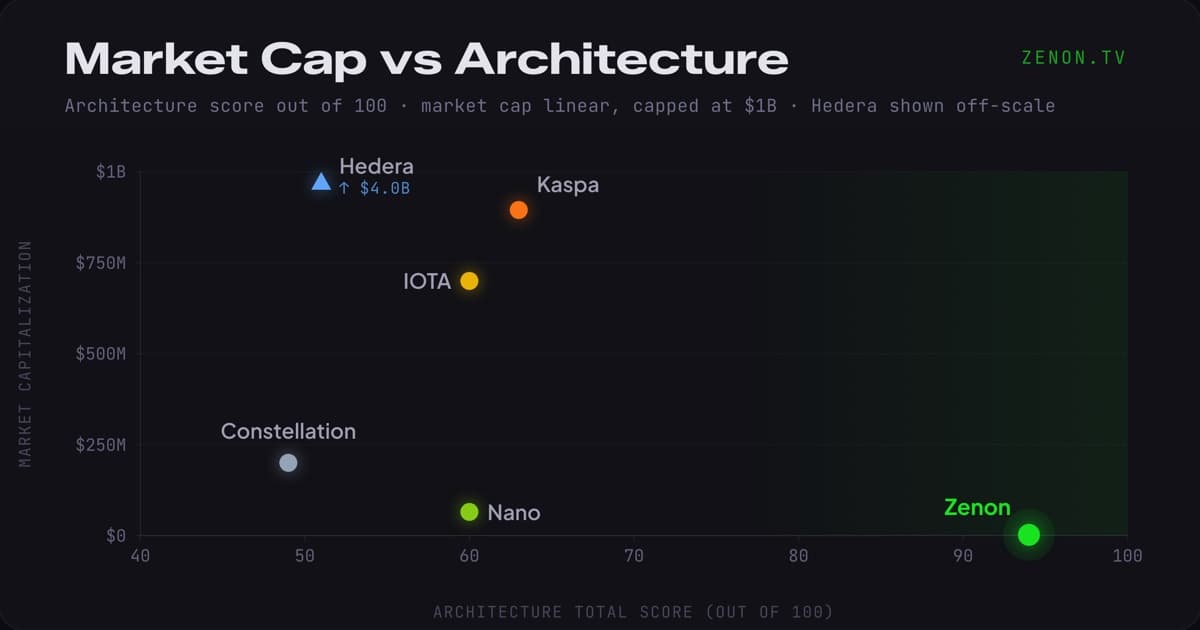
Six DAG projects ranked across architecture, economics, and survivability — the inversion between market cap and architectural correctness

Event Horizon Part II: A Time Slip
Why Phase 1 was a venture-scale staffing problem in 2021, and what changed between 2022 and 2025 to make it buildable for small teams

Reconstructing Phase 1
A verification-first reading of Zenon's Phase 1 architecture — substrate before application, drawn from Kaine's public record

Spam, Storage, and the 16 KB Data Field
Why the 16 KB data field is calibrated for post-quantum cryptography and how layered admission control resists resource abuse

A Sovereign Verification Kernel for Decentralized Intelligence
Deterministic coordination kernels for probabilistic AI — five patterns that transfer from protocol design to multi-agent orchestration

Move Packets, Don’t Trust. Verify
IP moves packets. Bitcoin orders events. Zenon verifies them. The narrow waist of cryptographic infrastructure.
Zenon: The Super Gravity of a Black Hole
Why verification-first architecture is the structural attractor that execution-first chains cannot become
The Planetary Scale Superorganism: Verification Loop Theory
Why verification-first architecture turns AI from a coding assistant into a constraint miner operating at the speed of compute
Decentralization by Topology
Three axes expose the gap between decentralization narrative and architectural reality

ISO 20022: A Blockchain Odyssey
Safety-critical standards across aviation, nuclear, automotive, medical, and financial systems converge on the same engineering principles. This paper maps those principles to blockchain architecture and demonstrates structural alignment with verification-first design.
Don’t Trust, Attempt to Falsify
How Popper’s falsificationism reframes blockchain verification and makes light clients first-class
Sovereignty, Not Decentralization
Why protocol architecture, not node count, determines whether a blockchain delivers sovereignty

Why Crypto is Stuck in 2014 — Part 2
From threads to fabrics: why the Network of Momentum is the internet of blockchains

Why Crypto is Stuck in 2014
The dimensional error that constrained the blockchain industry for a decade

Anatomy of a Full Stack Blockchain
The irreducible primitives a blockchain must handle beyond payments
5 Eras of Blockchain Computing
From timechain to sovereign era: the evolution of blockchain computing

The Next Evolution of the Internet
How the block-lattice architecture completes Bitcoin's verification-first vision
Billion-Dollar Maybe
Verification-first design and the future of trustless systems
What Does Zenon Have to Do with Bitcoin?
How verification-first architecture extends Bitcoin's security model
Bitcoin’s Unfinished Constraint Part II: Verify Bitcoin, Don’t Bridge It
How verification-first overlays can scale Bitcoin's SPV model
The Empty Quadrant
Why execution-first networks cannot migrate to verification-first without starting over
Verifiability and Fate-Sharing in a Cryptographic Hourglass
How TCP/IP's architectural principles map to verification-first blockchain design
You Can’t Hide Once You Run
Why 50 billion devices need verification-first infrastructure before pervasive autonomy