
A Decade of Decentralization
Post-hoc decomposition versus native composition — and why the difference is architectural, not rhetorical.
After a decade of iteration, blockchain architecture faces a philosophical fork in the road. One path continues post-hoc decomposition — the Ethereum tradition of starting with a monolithic foundation and then bolting on layer after layer to fix successive limitations. The other pursues native composition by design — building distinct, purpose-built primitives from the ground up so that every component serves a clear role without becoming a patch for the last.
A Decade of Post-Hoc Decomposition
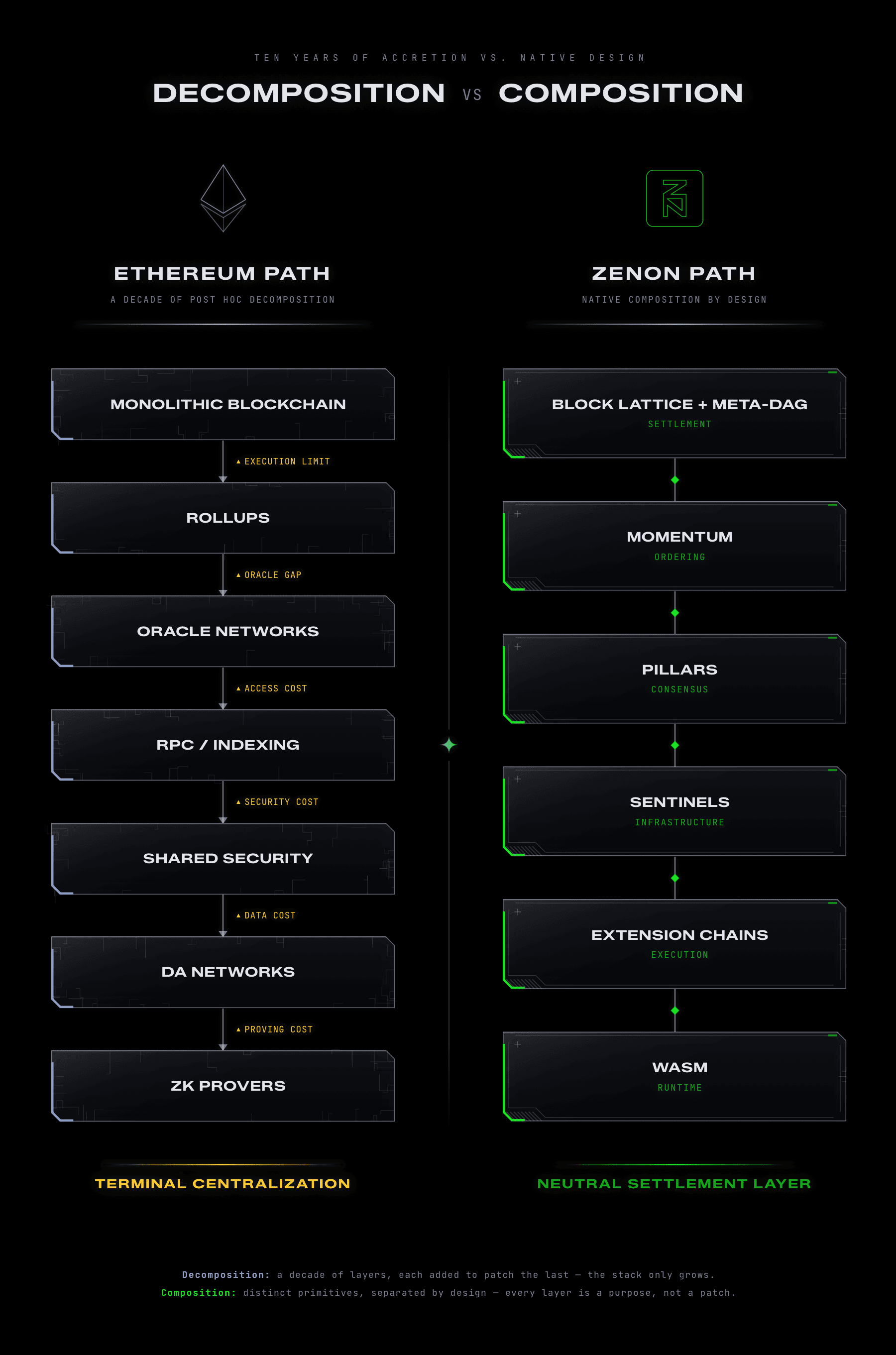
Ethereum launched with an elegant but ultimately limiting monolithic design in which execution, consensus, data availability, and security were tightly coupled. As usage grew, the ecosystem responded by decomposing the stack into specialized layers added reactively:
Rollups were introduced to overcome execution limits, moving computation off-chain while settling on the base layer. This created fragmentation and new centralization vectors around sequencers. Oracle networks were added to bridge real-world data, yet they introduced latency, trust assumptions, and ongoing costs. RPC and indexing services became essential for access, concentrating power in a small number of providers. Shared security mechanisms, data availability networks, and ZK provers were layered on top to address security, data, and verification needs, each bringing its own costs in capital, infrastructure, and computation.
The cumulative result is terminal centralization. The stack only grows. Costs compound across execution, oracles, access, security, data, and proving, and are ultimately borne by users and developers. Power consolidates around the operators of the critical middle layers.
Yet the deeper failure is not the number of layers. It is the persistent shared global state that decomposition never escapes. In any system built around globally shared mutable state, two orthogonal and compounding problems become structural.
MEV is not an implementation detail; it is an inevitable economic consequence. Because every transaction competes inside the same shared execution environment, reordering, insertion, and censorship create systematic extractable value. What began as a miner opportunity has matured into industrialized extraction dominated by specialized actors who capture the majority of the value created by the architecture itself.
State explosion is the more fundamental constraint. It is not merely that replaying history grows linearly more expensive. The shared state environment itself becomes unenumerable. The combinatorial space of possible interactions between contracts, accounts, and state transitions cannot be meaningfully counted, reasoned about, or secured at scale. Every new contract multiplies the possible states. Formal verification, auditing, and even basic system comprehension collapse under this complexity. This is not a temporary scaling issue. It is a structural ceiling that has quietly limited crypto’s ability to support real-world critical systems for over a decade.
Native Composition by Design
Zenon Network was built from the opposite premise. Rather than decomposing a monolith after limitations appeared, it composed a system of distinct primitives, each engineered for a single purpose and cleanly separated from the others.
Settlement rests on a dual-ledger foundation: a block lattice in which every account maintains its own independent chain for parallel transaction processing, paired with a Meta-DAG that handles consensus through virtual voting. Momentum provides canonical ordering through decentralized epochs. Pillars perform consensus via a leaderless hybrid PoW/PoS mechanism with stake-weighted virtual voting. Sentinels supply the infrastructure layer, relaying transactions, generating anti-spam proofs, and serving as user representatives without participating in consensus themselves. Extension chains enable flexible execution environments, and WASM provides the secure runtime.
The architecture terminates in a neutral settlement layer that does not privilege any particular execution environment or accumulate privileged infrastructure on top of it.
The governing principle is explicit separation of concerns: ordering is canonical and global; execution is local and parallel. Because state remains bounded to individual account chains and extension environments rather than exploding into a single shared namespace, the system stays enumerable and auditable. Because there is no global transaction pool in which every participant’s actions can be arbitrarily reordered against everyone else’s, most traditional MEV vectors are eliminated at the protocol level rather than mitigated after the fact through additional layers or off-chain markets.
Architecture, Not Narrative
The worst outcome for the industry would be one that continues to rally around the language of decentralization while architecturally producing the opposite result: systems that concentrate extractable value, centralize infrastructure control, and create state spaces too complex for participants, auditors, or regulators to fully understand or secure.
Decentralized neutrality requires more than narrative. It requires an architecture that bounds state complexity, separates ordering from execution so that MEV cannot be systematically extracted from shared state, keeps the neutral settlement layer genuinely neutral, and keeps the possible interactions within the system enumerable where it matters. Only then can critical real-world systems place meaningful trust in the foundation beneath them.
One path keeps adding layers while the shared state beneath them becomes unmanageable and extractable. The other accepts harder design choices early so the system does not pay compounding architectural debt forever. The difference will determine whether blockchain technology remains a speculative asset class or becomes infrastructure capable of supporting serious economic and social coordination.